















When “functional training” stops being a slogan
Functional training is probably one of the most widely used — and least understood — terms in modern training.
In recent years, it has become an undefined catch-all: spectacular exercises, unstable surfaces, high-intensity circuits, often without any real progression logic.
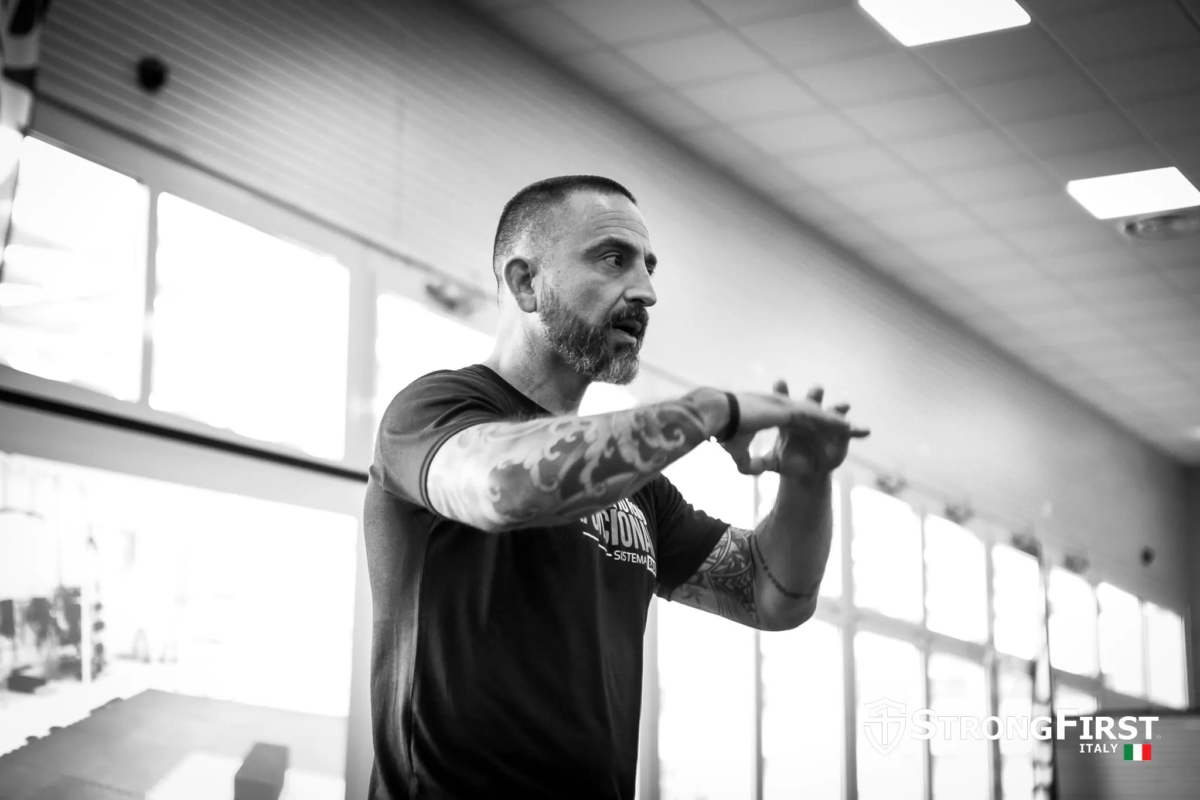
It is precisely from this ambiguity that Tiago Proença’s presentation at the StrongFirst Summit of Strength 2026 in Cesena began.
His goal was not to propose yet another “functional” variation, but to address a much more concrete issue:
how to transform a vague training concept into a structured, teachable, and progressive system.

From functional training as a label to functional training as a system
The core of the presentation is encapsulated in one clear phrase:
“The BASE System was created to take our students from beginner to advanced level in a simple, practical, and organized way.”
The point is not to invent new exercises.
The point is to build a training grammar capable of guiding the student over time.
From this perspective, “functional” stops being an aesthetic or a fad and becomes an instructional system.
It is a vision perfectly aligned with the StrongFirst culture and the SIDEA philosophy:
less randomness, more structure;
less variety for its own sake, more progression.
BASE: four principles, a clear structure
The model proposed by Proença is based on four fundamental principles:
- B – Base of training outside machines
Building strength starts in free contexts, unconstrained by machines. - A – Analysis of functional movement based on multi-joint exercises
Movement is analyzed through multi-joint exercises. - S – Strength synergy focused on multi-joint exercises
Strength is a synergy between segments, not the sum of isolated muscles. - E – Evolution through movement patterns
Progression occurs through the evolution of patterns, not just by increasing the load.
This last point is probably the most relevant:
movement quality becomes the true driver of progression.
From beginner to advanced student: the STD
The system organizes the training journey through the Stages of Training Development (STD):
- Stage 1 – Strength School
Educational phase, focused on learning movement patterns - Stage 2 – Transition
Consolidation of fundamentals and introduction of intermediate testing (8–15 RM) - Stage 3 – Advanced
Specific work on strength (1–6 RM) and advanced programming
Classification is not based on strength alone, but also on:
- experience
- preferences
- level of commitment
This is a key aspect:
not all students progress in the same way, and not everyone is ready for the same type of load or complexity.
Warm-up as a system, not as a ritual
One of the most interesting parts concerns the warm-up.
In the BASE System, the warm-up is not a generic phase, but a structure organized around specific joint functions:
- glenohumeral mobility
- scapular stability
- thoracic mobility
- lumbar stability (anterior and posterior)
- hip mobility
- knee stability
- ankle mobility
- integrated exercises
The result is a true decision-making grid:
it is no longer about simply “warming up”,
but about preparing the body specifically for the session.
This approach makes the warm-up:
- replicable
- modular
- consistent with the main workout

Movement patterns: the true unit of training
The system is based on a classification of 16 movement patterns, plus 3 anti-movements for the core.
These include:
- push and pull (horizontal and vertical)
- knee and hip dominance (symmetric, asymmetric, unilateral)
- spinal movements
- core stabilizations (anti-extension, anti-rotation, anti-lateral flexion)
This approach radically changes the way programming is done.
You no longer think in terms of exercises, but in terms of movement families.
The benefit is twofold:
- it prevents random programming
- it allows for more precise and consistent progressions
From simple to complex: the logic of progression
A very clear example presented during the session is the deadlift progression:
- kettlebell deadlift
- trap bar deadlift
- conventional deadlift
The principle is simple, yet fundamental:
complexity is not rushed, it is built.
You transition from more accessible, self-organizing exercises
to variations that require greater control and load tolerance.
It is not just an increase in intensity.
It is an increase in competence.

Critical analysis: what makes the BASE System interesting
The main value of the model is not its absolute originality.
Many of its elements — patterns, progressions, multi-joint work — are already present in other training systems.
The point lies elsewhere:
the BASE System organizes what is often applied in a disorganized way.
In this sense:
- it does not invent exercises
- it does not introduce completely new concepts
- but it provides a clear operational structure
And this, in daily practice, is what makes the difference.
Practical implications for trainers and coaches
Several concrete insights emerge from the presentation:
- functional training is only useful if it becomes a progression, not just a label
- the warm-up can be a technical tool, not an automatic routine
- multi-joint patterns represent a true school of movement
- access to advanced work must be built, not rushed
In summary:
without a structure, even the best exercise loses its meaning.
Conclusion
Tiago Proença’s presentation brought functional training back to a more concrete ground: that of structure.
The BASE System does not propose an alternative version of strength,
but a more orderly way to teach it.
For those working in the gym, the message is clear:
it is not the choice of exercise that makes the difference,
but the ability to place it within a consistent progression.
And this is precisely where many systems fail —
not due to a lack of ideas, but due to a lack of structure.
The goal is to bring order to chaos!